

Engaging the senses
The Dark Skies Station is designed to help visitors connect with the universe, the best way is through our state-of-the art telescope, but we also included other ways and tried to engage as many senses as possible. When attending one of our events, you can:
- See images of Dark Skies over the National Park
- Watch films about our status as an International Dark Sky Reserve
- Touch and handle meteorites from our collection (when possible)
- Smell the natural scent of the wooden building
- Hear audio inside and outside the building
Sound is key
There are two main sound features at the Dark Skies Station. The first is an original soundscape created with sounds from the NASA archive, which plays as you walk from the classroom into the telescope room. Listen out for this when you're at one of our events, how many of the sounds do you recognise?
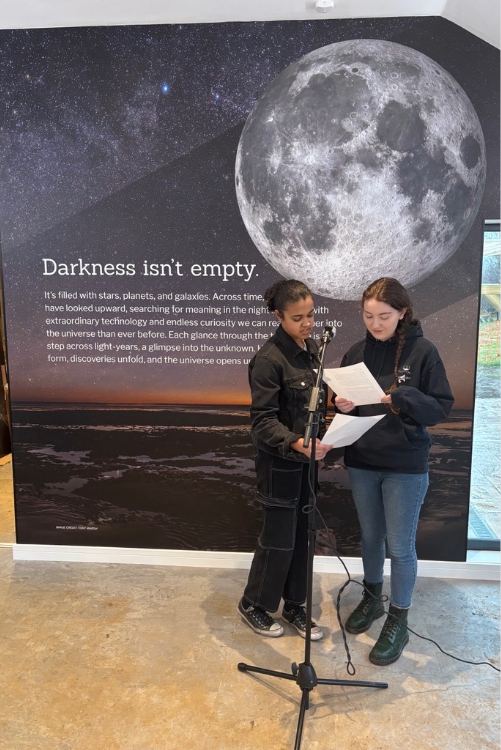
The second sound feature is located outside the building, and was recorded by local young people, including members of our Youth Voice group. It features two tracks, one is an introduction to Dark Skies and the second is an exploration of the origins of planet names.
Listen to the tracks and read the transcripts below.
Listen below
Introduction to the Dark Skies Station (MP3)
Transcripts
Track one:
Darkness isn’t empty. It’s filled with stars, planets and galaxies. Across time, people have looked upward, searching for meaning in the night sky. Now with extraordinary technology and endless curiosity we can reach deeper into the universe than ever before. Each glance through the telescope is a step across light-years, a glimpse into the unknown. Here, questions form, discoveries unfold, and the universe opens up.
The North York Moors National Park is an official International Dark Sky Reserve which means its one of the best places to experience the wonders of the sky at night.
Our Dark Skies Station, here at Danby Lodge National Park Centre was made possible with support from the Wolfson Foundation, the Open University, Whitby and District Astronomical Society and Dark Sky consultant Richard Darn.
Track two:
Mercury, Venus, Mars, Jupiter, Saturn, Uranus, Neptune. These are our neighbours in the solar system, and we’re so used to hearing their names, but where do these names come from?
Ancient civilizations including the Babylonians, Greeks and Romans made connections between their gods and celestial bodies like planets. In the Solar System all planets (except for Earth and Uranus) are named after Roman gods. But it’s a bit more complicated than that, the Romans often borrowed gods from other cultures, giving them new names. So although, our neighbours in the solar system have Roman names the gods themselves come from ancient Greek culture - Mercury is Hermes, Venus is Aphrodite, Mars is Ares, Jupiter is Zeus, Saturn is Cronus and Neptune is Poseidon. However, Uranus - the sky god - got to keep his Greek name. The other exception is our own planet; the name Earth comes from and Old English and Germanic and simply means ‘ground’.